
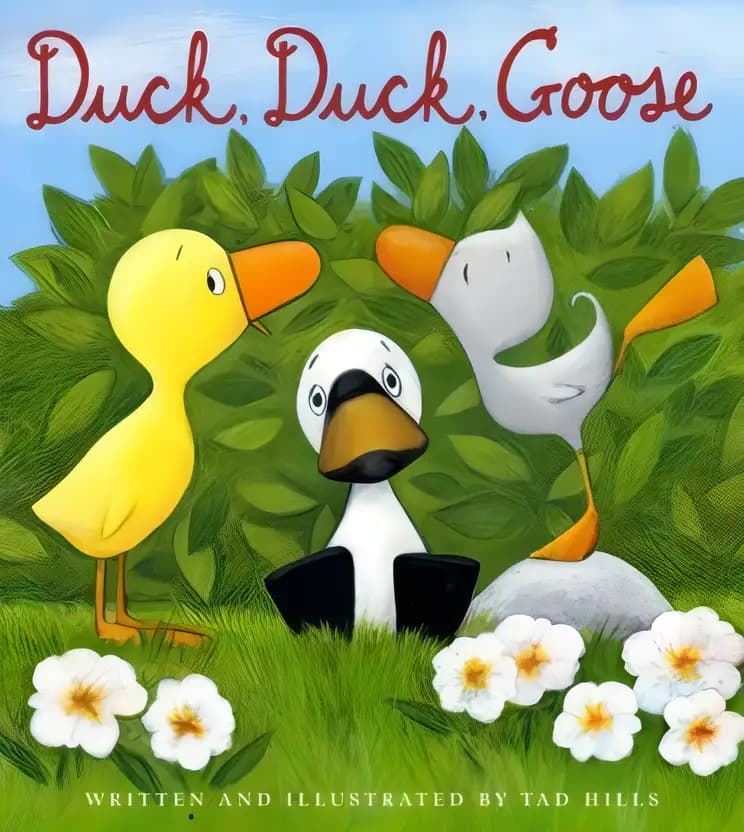
Duck, Duck, Goose
#2 of 14 in Duck & Goose Series
What’s inside...
The beloved, classic, and New York Times-bestselling odd couple Duck & Goose are back, and this time their friendship is put to the test! Duck & Goose, Goose & Duck. Feathered friends forever . . . or are they? You see, there's a challenge to their friendship: a little whippersnapper of a duck named Thistle. Thistle is good at everything (or so she thinks), from math to holding her breath to standing on her head. Duck thinks she's fantastic. But Goose does not! And so Goose is faced with a problem close to the hearts of children everywhere: What happens when your best friend makes a new friend? PRAISE FOR THE DUCK & GOOSE SERIES: 'Duck and Goose have taken their places alongside Frog and Toad and George and Martha as fine examples of friendship, curiosity and problem-solving.'--Kirkus Reviews 'Charming, funny, simple, and surprising. . . . Hills is master of the light comic touch.'--The Boston Globe
Character compass
Duck
Goose
Thistle
Discussion points
What do you think makes Duck and Goose such good friends despite their differences?
Why do you think Duck was confused when the bluebird landed on his head?
How did Duck and Goose solve their problem at the end of the story?
What would you do if you found something special and couldn't decide who it belonged to?
Tip: Role play these questions
Encourage your child to express their thoughts on friendship and sharing, drawing parallels to their own experiences.
Discuss the emotions each character might be feeling during key moments in the story, helping your child understand different perspectives.
Highlight the importance of communication and compromise as shown by Duck and Goose's resolution.
Use facial expressions and voice modulation to mimic the characters while reading, making the story more lively and engaging.
Key lessons
Example Lesson: The importance of friendship
Explanation: The story demonstrates how Goose joins Duck and his friends in various activities, showcasing the joys and the complexities of friendship.
Real-World Application: Children can learn to appreciate the value of including others and building friendships, which is vital for their social development and emotional well-being.
Example Lesson: Understanding and respecting differences
Explanation: Throughout the book, Duck and Goose have different opinions and ways of doing things, which teaches the value of understanding and respecting individual differences.
Real-World Application: This lesson helps children navigate diverse social settings and teaches them to be considerate and accepting of others who may seem different from themselves.
Example Lesson: Conflict resolution
Explanation: Duck and Goose face various challenges and disagreements. The story illustrates how they address and resolve these conflicts, emphasizing the importance of communication.
Real-World Application: Children are equipped with strategies to handle disputes in everyday situations, be it at home, in school, or during play, fostering a healthy approach to conflict resolution.
Example Lesson: The value of cooperation
Explanation: The game 'Duck, Duck, Goose' requires taking turns and playing fair. The story highlights the importance of cooperation and following rules to ensure everyone enjoys the game.
Real-World Application: This promotes the concept of fairness and teamwork among children, skills that are essential in group activities and collaborative environments.
Example Lesson: Patience and turn-taking
Explanation: As the characters in the book wait for their turn in the game, they exhibit patience, a vital social skill.
Real-World Application: Teaching children the importance of waiting their turn can help them develop patience in real-world scenarios such as sharing toys or waiting in line.